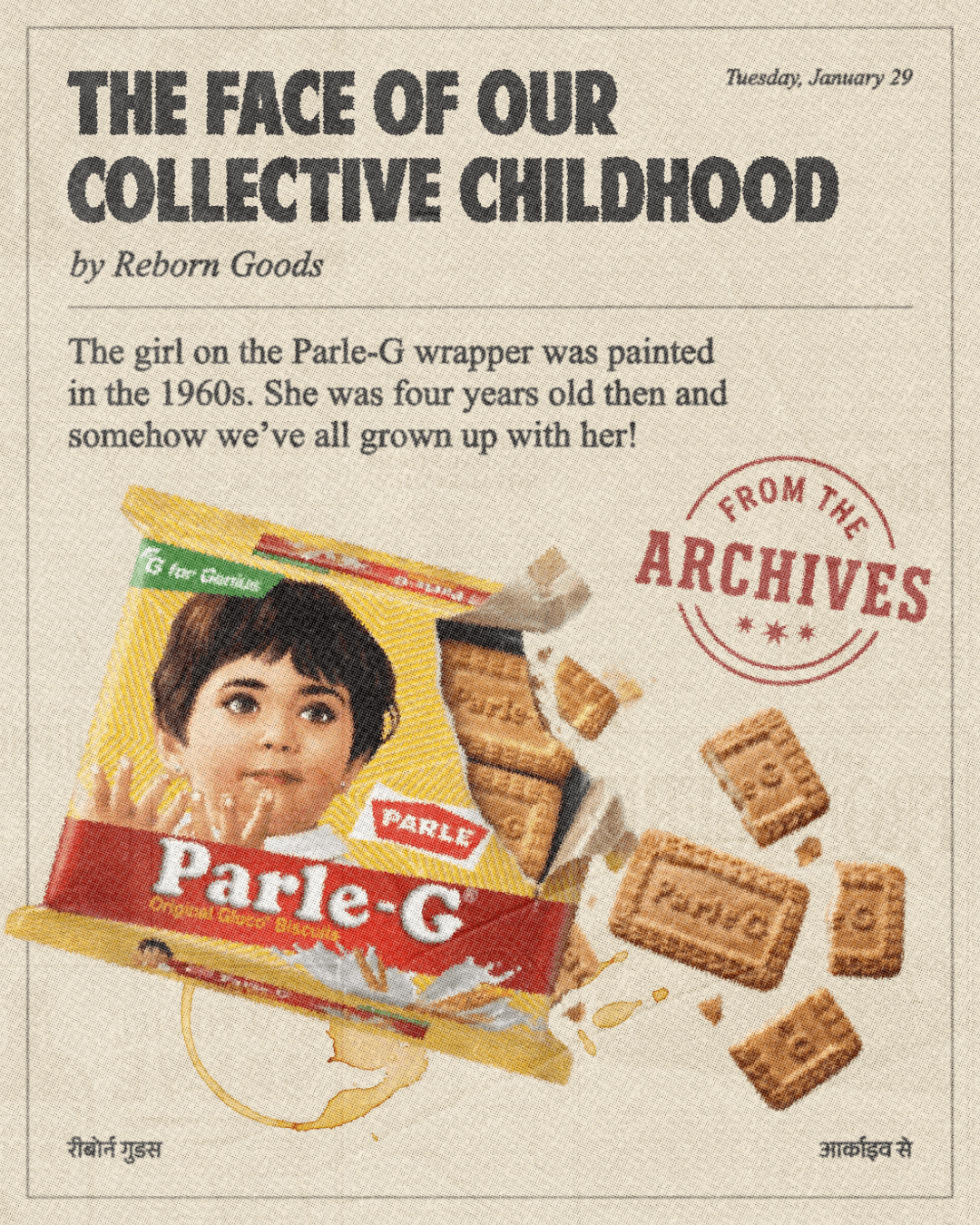
From the Archives: The Parle-G Girl we all grew up with!
In 1939, Mohanlal Dayal Chauhan launched Parle Gluco- a glucose biscuit for Indian pockets. Biscuits back then were British, buttery, expensive. Chauhan flipped the narrative: why should only the English have tea-time fun? He made an Indian alternative. Dry, slightly sweet, affordable. The kind that made chai better.
Then came the 1960s. Competition arrived. Brands with similar names, similar wrappers, similar everything. People got confused. So Parle went to Everest Advertising and asked for something instantly recognizable. Something that would cut through the clutter.
Maganlal Dahiya, heading the creative department, directed his illustrators to paint different versions of a mascot. One of those paintings became the Parle-G baby. A young girl, maybe four or five years old, on a yellow and white wax-paper wrapper.
In 1982, Parle Gluco became Parle-G. G for Glucose. G for Genius. G for whatever you want it to mean. The name changed. The wrapper stayed. The girl stayed. She has stayed for over six decades.
She was supposed to age. She was supposed to be redrawn for modern audiences, updated for contemporary aesthetics, refreshed for new markets. She was supposed to evolve with the times, adapt to design trends, respond to consumer research.
She just stayed. Same illustration. Same yellow. Same white. Same girl who looks exactly the way she looked in the 1960s.
The Wrapper That Became a National Anchor
Walk into any household in India and you'll find that yellow wrapper. Sometimes in the kitchen cupboard. Sometimes in a dabba. Sometimes crumbled at the bottom of a school bag. Always there. Always recognizable.
The wrapper design is so deeply embedded in Indian visual memory that it functions as shorthand for home. For childhood. For the specific sweetness of glucose biscuits dunked in chai. For afternoons when ₹5 could buy comfort.
In 1982, Parle Gluco was rebranded to Parle-G, but the packaging stayed consistent. The product was packed in wax paper of yellow and white wrapper that featured a very young girl. Later, the material changed from wax paper to plastic wrapping, airtight, keeps biscuits fresh longer—but the design remained identical. Same girl. Same yellow. Same font.
This continuity is remarkable in an era where brands undergo identity refreshes every few years. Where consumer packaged goods companies test new designs, A/B test colors, iterate based on market research. Parle-G just kept the 1960s illustration and called it a day. For six decades.
Parle-G never changed the logo as it is crucial to illustrate the originality and stability of the product. The logic is straightforward: if it works, leave it alone. The wrapper became more than packaging. It became recognition. It became trust.
What the Girl Represents
For years, people thought the girl was Sudha Murthy, Infosys Foundation Chairperson. Made sense—a real person, a real story, a real connection. Except she isn't. It is actually a painting created by illustrators at Everest Advertising under Maganlal Dahiya's direction.
The girl isn't anyone. She's everyone. Every Indian child who ate Parle-G after school. Every kid who dipped biscuits in chai while adults talked. Every afternoon snack. Every train journey. Every moment when ₹5 was enough.
In the '60s, Parle marketing team reached out to Everest Advertising because in those days, biscuits were largely consumed by children. Hence, a child mascot. But over time, the biscuit's consumer base expanded to include a significant number of adults. The girl stayed. She works for both. A four-year-old sees herself. A forty-year-old sees childhood.
The genius of the wrapper is that it never tried to be more than it was. A simple illustration. A recognizable color combination. A design so functional that changing it would be absurd.
The Economics of Familiarity
Parle-G now sells over a billion packets a month, around 121 biscuits per Indian. The numbers are staggering. A 2011 Nielsen survey reported that it is the best-selling brand of biscuits in the world. Not just India. The world.
Part of this success is the product itself- affordable, glucose-loaded, decent taste, available everywhere. But part of it is the wrapper. That yellow packet signals familiarity. It signals consistency. It signals that what you bought in 1985 is what you're buying in 2026.
In a market where everything changes, brands rebrand, products reformulate, packaging evolves—Parle-G offers visual stability. The wrapper is a promise: we're still the same. We're still here. We're still ₹5 (give or take inflation).
This stability builds trust in ways advertising campaigns struggle to achieve. When the packaging looks the same for sixty years, the assumption is the product inside is the same. The taste is the same. The quality is the same. The experience is the same.
Whether that's true or false is almost irrelevant. The perception is the reality.
Design That Serves Function
The Parle-G wrapper was designed to solve a problem: brand confusion in the 1960s. It succeeded. Too well. The design became so effective that changing it would be a business risk. Why fix what works at scale?
The yellow and white combination is instantly visible on crowded shelves. The girl is recognizable from across a store. The font is readable. The design is simple enough to reproduce cheaply across millions of packets. Function determined form. Form stuck around.
Compare this to contemporary D2C brands where design is treated as identity expression, as brand story, as aspiration. Parle-G's design is purely utilitarian. It works. It's cheap to produce. It's easy to recognize. That's enough.
There's something refreshing about packaging that serves its purpose and exits stage left. The wrapper protects the biscuits. It communicates the brand. It triggers recognition. End of job description.
The Wrapper That Became Culture
The Parle-G baby has transcended packaging. She's a cultural icon. She shows up in memes, art installations, social commentary. She's referenced in conversations about Indian childhood, about affordability, about class, about access.
The wrapper represents more than a biscuit. It represents the democratization of snacking. Starting with orange candy, it was the year of 1939, when Parle started its biscuit-making operations with the name Parle Gluco. It was easily accessible at an affordable price. Back then biscuits were only meant for elite class as they were mostly imported and expensive. Parle made them available to everyone.
The yellow wrapper became a leveler. It sat in rich homes and poor homes. It traveled in school bags and briefcases. It was packed in tiffins and sold at railway stations. Same biscuit. Same wrapper. Same price point.
In a country obsessed with hierarchy, that yellow packet represented something rare: a product that crossed class boundaries without apology. The wrapper didn't try to be premium. It didn't try to be aspirational. It just tried to be recognizable and affordable. It succeeded at both.
What Modern Brands Miss
Today's brands agonize over packaging. Focus groups, consumer research, trend analysis, design iterations. They test colors, fonts, materials, messaging. They worry about shelf presence, unboxing experiences, Instagram aesthetics.
Parle-G skipped all of that. They found a design that worked in the 1960s and kept it. Sixty years later, it still works. It works because it's familiar. It works because it's consistent. It works because it does its job- protect biscuits, communicate brand, trigger purchase; without trying to be anything more.
There's a lesson here about design humility. About letting the product be the hero. About trusting that good enough, repeated consistently, becomes iconic through sheer persistence.
The Parle-G wrapper is iconic because it's been around so long that removing it would feel like loss. The design isn't particularly beautiful. It isn't particularly innovative. It's just been there, unchanged, reliable, for six decades.
That constancy is the brand.
The Archive That Lives
The Parle-G wrapper is an archive in active use. Every time someone buys a packet, they're buying a piece of Indian visual history. The 1960s illustration. The yellow and white combination. The font that's been the same forever. The girl who never ages.
Most archives live in museums. This one lives in every kirana store, every supermarket, every railway station in India. Active. Functional. Unchanged.
The wrapper that was designed to solve brand confusion in the 1960s has become the visual anchor for Indian childhood across generations. Your grandmother bought it. Your parents bought it. You buy it. Your kids will buy it. Same wrapper. Same girl. Same yellow.
The Parle-G baby is 60 years old and still four years old. She'll probably stay four forever. The wrapper will probably stay yellow forever. The design will probably stay unchanged forever.
Because when something works this well for this long, changing it would be absurd.
The biscuit you bought in 1985 had the same wrapper as the biscuit you'll buy in 2026. That's not nostalgia. That's strategy. Visual consistency as brand equity. Familiarity as trust. Repetition as recognition.
The Parle-G wrapper proves that sometimes the best design move is to find what works and leave it alone for sixty years.
FROM THE ARCHIVES — Reborn Goods' series on Indian packaging that became iconic by refusing to change. Parle-G: the yellow wrapper that built trust through consistency, one packet at a time, since 1939.


Let’s keep in touch.
Discover more. Follow us on Substack and Instagram.