Product > Brand?
The Brand Can't Outrun the Product
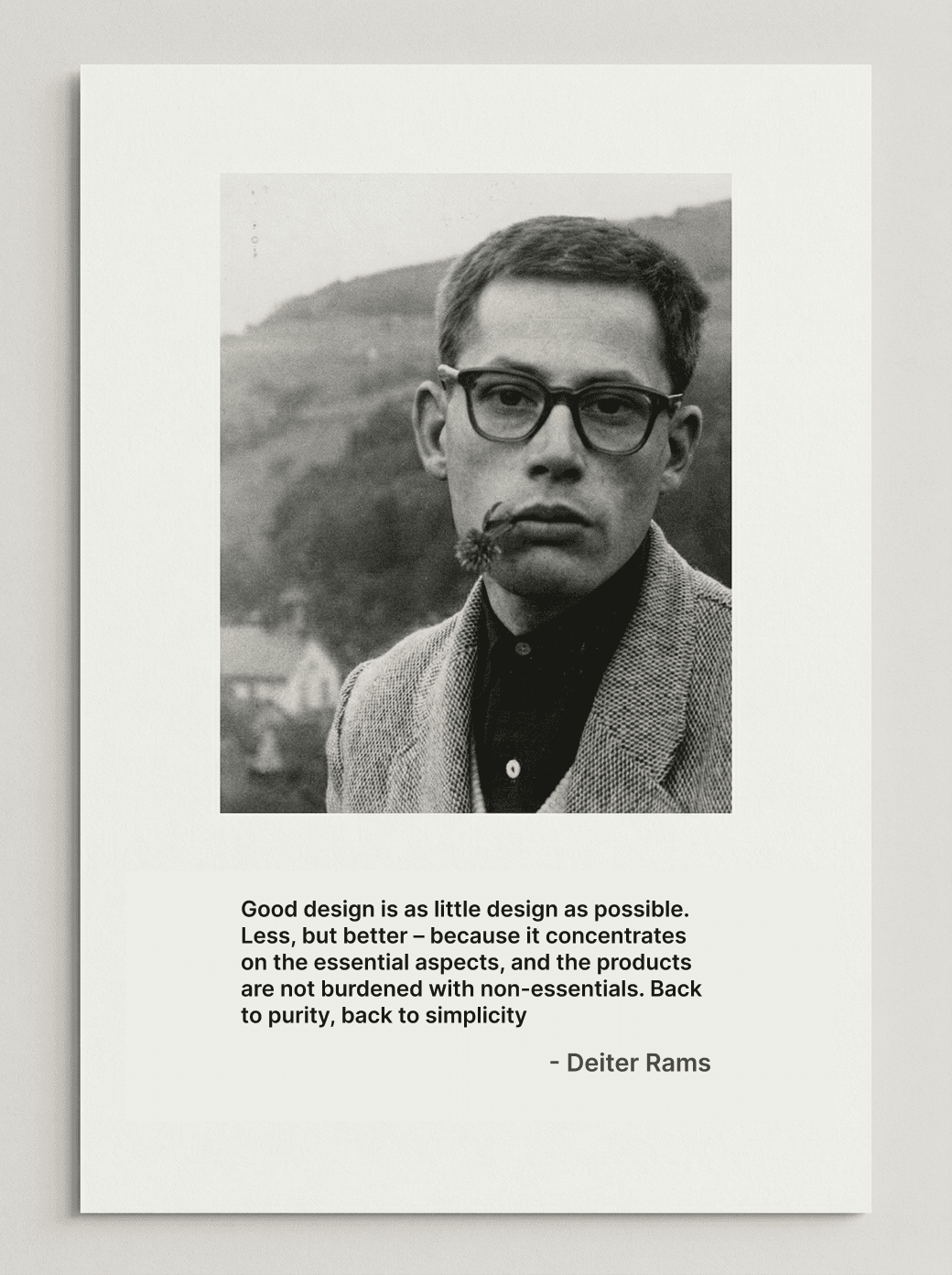
In the late 1970s, Dieter Rams looked around at the world he'd helped create and saw "an impenetrable confusion of forms, colors, and noises." As chief design officer at Braun for over 40 years, he'd designed more than 500 products. He was, by any measure, a significant contributor to the visual landscape of consumer goods. So he asked himself a question that would reshape modern design: Is my design good design?
His answer became ten principles, but one cuts deepest: Good design is honest. It does not make a product more innovative, powerful, or valuable than it really is. It does not attempt to manipulate the consumer with promises that cannot be kept.
Rams understood something fundamental. A product has a function- it solves a specific problem for someone specific. Design is how that function gets expressed in the world. When design is honest, it emerges from what the product actually does. When design is dishonest, it performs a value the product doesn't have. The first creates trust. The second creates returns.
This principle extends far beyond Braun calculators and coffee makers, into every discipline where something is made and put in front of people. Including brands today. Especially D2C brands in India today.
India's D2C market is on track to cross $100 billion in 2025. Nearly 11,000 brands now operate in the space. But here's the uncomfortable truth: 60–65% of Indian D2C brands remain stuck in the ₹1–50 crore revenue band, with very few reaching the ₹100 crore mark. The problem isn't demand. It's not even capital. The problem is that most brands are building backwards.
They're layering brand- mood boards, positioning decks, influencer partnerships, Instagram aesthetics- onto products before they've figured out what the product actually does and whether it does it well. Design performing a value the product doesn't have. Rams would recognize this mistake immediately: dishonest design, making products appear more innovative or valuable than they really are.
When the Story Runs Ahead of the Thing
Take the beauty category. Sugar Cosmetics built strong youth-focused positioning and influencer-first demand but reported a revenue decline and margin stress in FY25 as retail expansion and marketing costs weighed on the P&L. The brand was distinctive, the aesthetic was on point, the influencer strategy was textbook. But underneath, the fundamentals—product differentiation, unit economics, repeat purchase rates—couldn't support the weight of the brand being built on top of it.
Or consider the broader pattern. 62% of founders report creative fatigue, where repeated creatives fail to sustain ROAS despite higher spends, while 55% admit to under-investing in CRM and retention, with most brands reporting repeat purchase rates of just 10–30%. Translation: the brand looks great in the feed, but the product doesn't earn a second purchase. The design is performing innovation it doesn't deliver.
This is Rams' problem, just in consumer goods instead of electronics. Brands layering visual language onto products that don't have clear, defensible function. Design that makes promises the product can't keep.
The Product Determines the Brand, Not the Other Way Around
The strongest brands in India's D2C ecosystem didn't start with brand. They started with a product that solved a specific problem for someone specific, in a moment that was specific. Then they let the brand emerge from that.
Minimalist, the skincare brand, is the counterexample that proves the rule. It scaled to an ARR in the ~₹500 crore range and attracted acquisition interest—an example of how product + supply fundamentals can deliver profitable scale. The brand didn't come first. The product thesis came first: scientifically-backed formulations at transparent pricing, sold directly with education, not aspiration. The brand- minimal packaging, ingredient-led naming, no-nonsense copy followed from what the product actually was. Form following function. The distinctiveness was a byproduct of the honesty, not the goal.
Compare that to the typical playbook. Brands use social content, creator reviews and D2C funnels to reach an early cohort, then expand catalogue (haircare, skincare, bodycare), invest heavily in marketing, and experiment with quick commerce and marketplaces. Notice the sequence: brand-building happens before the product earns it. Category expansion happens before the first category is mastered. Distribution scales before unit economics are proven. The brand is running ahead of the product, trying to compensate for what the product hasn't yet earned.
This works for exactly as long as capital lasts. Then the product has to stand on its own. And if it can't, no amount of brand-building will save it.
What Honest Design Actually Looks Like
Rams believed that good design should strip away everything unnecessary to focus on the product's core purpose. "Less, but better" his most famous principle. Not minimal for the sake of aesthetics, but honest about what the product actually does.
Good design is convergent. It moves toward what the product demands, pulled inward by the specific truths of the thing being expressed. When done well, it arrives at something that feels inevitable; as though it couldn't have been anything else.
Le Labo understood this. Perfume made one bottle at a time, blended by hand, in front of the person buying it. That understanding of process, pace, radical transparency, determined everything else. Laboratory glass because a working lab uses laboratory glass. Typewriter-font labels bearing the buyer's name and date because this isn't a unit, it's an event. The product's internal structure became the brand's language. Nobody designed it in the traditional sense. The product designed the brand, because they understood the product completely.
Aesop found the same principle through a different door. The formulations are light-sensitive and require amber glass to prevent UV degradation. Most brands would treat this as a constraint to design around. Aesop treated it as a truth to design from. The amber bottle born of formula requirements became the most recognized element of the brand identity. More recognizable than the logo. The function said what it needed. The form followed.
Instagram understood this at platform scale. Its product is other people's images. When the app was redesigned in 2016, the entire interface was stripped to near-monochrome. Black, white, grey. The reasoning: once inside the app, the colour should come entirely from the community's content. The interface had to disappear so the product could be seen. Design making itself invisible so function could be visible. Rams' principle of "good design is unobtrusive" products fulfilling a purpose are like tools, their design should be neutral and restrained to leave room for the user's self-expression.
Three different products. Three different functions. One principle: honest design that doesn't pretend to be more than what it is.
The Indian D2C Reality Check
The standard brand-building sequence goes: define your audience, establish positioning, build the visual identity, then apply it to the product. It's taught in business schools, sold by agencies, reproduced in every brand strategy deck. The implicit assumption: brand is something you design and attach to a product, that identity is a layer you apply rather than a truth you extract.
Rams saw this exact mistake in consumer electronics. Designers reaching for visual language before they understood what the product needed to do. The result: products that looked considered but made promises they couldn't keep.
The Indian D2C equivalent is everywhere. The story is written first. A colour palette derived from what looks premium in the category, not what's true about this specific product. Tone of voice developed from audience research rather than from what the founder actually built and why. The whole apparatus of visual expression decided in advance, and the product fitted into it afterward.
Beautiful, sometimes. But dishonest in exactly the way Rams meant: design that manipulates consumers with promises the product cannot keep.
And the customer can feel it. High levels of unsold or returned inventory, coupled with only incremental differentiation versus competitors, make repeat purchase rates low and per-customer lifetime value insufficient to recover CAC. The brand made a promise. The product couldn't keep it. No amount of creative refresh will fix that gap.
Form as Compensation Mechanism
Strip away the strategy decks and brand is what a product leans on when it can no longer stand on its own.
When what you've built is genuinely distinct, when you've solved a real problem completely, the brand that comes from it is inevitably honest. The product makes the argument. Customers who encounter it understand it. Word spreads because the thing itself is worth spreading. Brand, in this context, is simply the honest expression of something that already exists in the product's function.
But when substantive differences between products disappear, when every competitor can manufacture something equally good, when white-labelling is the industry reality, brand becomes the differentiator by default. Not because it's the strongest argument, but because it's the only one left. Form compensating for function, because function can no longer carry itself.
The mistake founders make is reaching for this compensation mechanism before they've built anything worth compensating for. They treat brand as the builder of product value when it is, at best, the amplifier of it. A brand applied to a weak product doesn't strengthen the product. It makes the weakness more visible, eventually, to more people.
As competition intensifies and capital becomes more selective, scalable brands are defined not by speed but by the ability to compound cash flows, institutionalize processes, and scale distribution beyond digital platforms. Translation: the brands that survive are the ones where the product can stand on its own. The brand amplifies what's already there. It doesn't create it from nothing.
Start With What It Does
If form follows function, then before you design anything, you have to understand the function completely. Not adequately. Completely.
What problem does the product solve? What is it made of, and why those materials? What is the making process? How is it used, what is the physical and emotional texture of that moment, and what does the person reaching for it genuinely need?
The visual language, the naming, the palette, the materials all of it should be extracted from those answers rather than applied on top of them. The palette comes from the product's nature. The texture references come from how it's made. The directional feel comes from the moment of use. The brand is the concentrated expression of everything the function has already decided.
No amount of marketing can permanently separate a brand from its product. The customer uses it, holds it, smells it, opens it, returns to it or doesn't. Eventually, the product is all that remains of any promise the brand made.
The founders who get this right treat brand-building as an act of translation, not invention. They're not creating a perception. They're finding the most honest way to express something that already exists—in the product's materials, in its making, in the ritual of its use, in the irreducible thing it does for the person who reaches for it.
When that translation is true, the brand feels inevitable.
Rams understood this in the late 1970s, staring at a world of visual noise he'd helped create. His answer: stop making products appear more valuable than they are. Start with what the thing actually does. Design honestly from that truth.
The real strategic question was never how to differentiate. It was always how deeply you understand what you've made.
In a market of 11,000 D2C brands where 60–65% remain stuck below ₹50 crore in revenue, that understanding is the only moat that matters. The brand can run for a while. But eventually, the product catches up.
Start there.


Let’s keep in touch.
Discover more. Follow us on Substack and Instagram.